WORKSHEETS
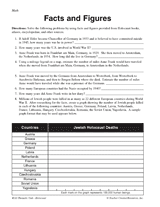
In this printable, students complete mathematical word problems while learning facts about the Holocaust.This activity…
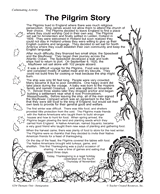
This printable about Colonial times tells the story of the Pilgrims' landing in America.
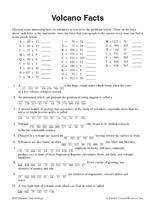
Students puzzle out new facts about volcanoes by completing arithmetic problems.
CLASSROOM TOOLS
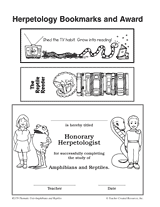
Use these bookmarks and badges to honor your students' participation in learning about amphibians and reptiles. This…
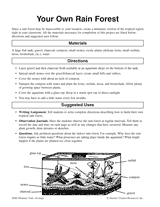
Create a miniature version of a tropical region right in your classroom, using these instructions for putting together a…
Math can easily be incorporated and correlated to a unit of studies on plants. Here are some suggestions for you to try.
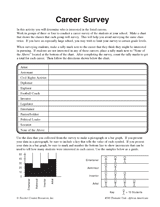
Students conduct a survey of their school to find out what careers students are interested in pursuing.
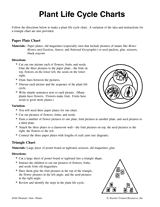
Follow the directions in this printable to make a plant life cycle chart.
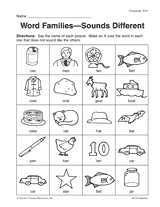
In this language arts activity, students identify words that don't rhyme enhancing their verbal skills. Use this…
ACTIVITIES
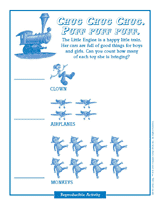
Children practice counting with this activity which goes along with the reading of The Little Engine That Could.
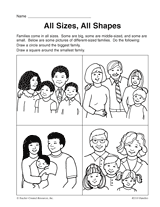
In this counting activity, students are asked to compare sizes of different families.
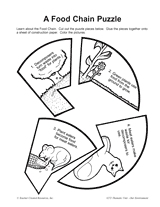
This simple puzzle teaches students about the food chain.
Students match animals with their ecological habitats.
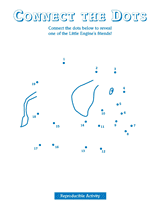
Children connect the dots to reveal one of the Little Engine's friends!
REFERENCE
An African-American astronomer, Benjamin Banneker's accomplishments are reviewed along with related activities.
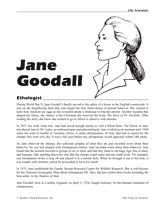
A review of Jane Goodall's life and accomplishments are complemented with related activities.
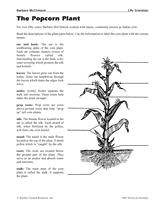
Students label the parts of a corn plant.
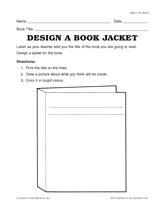
Students design a new book jacket.
Use this writing graphic organizer to help your students pretend to be a character in a book and create journal entries…
LESSON PLANS
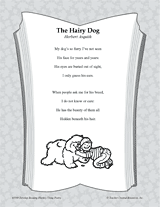
Read this poem about a hairy dog, then have students compare and contrast the dog in the poem with other dogs they know.
In this poetry activity, students attempt to determine the main idea the author wishes to present.
Use this poem to teach students about caring.
Students will construct a drawing demonstrating understanding of descriptive details from the poem and other texts.
Build vocabulary knowledge and skills with these activities.